
Presentation
Geographical location
Corsier-sur-Vevey is one of the 309 municipalities in the Canton of Vaud. It forms part of the Riviera–Pays-d’Enhaut district. It borders the Fribourg municipalities of Châtel-St-Denis, Attalens and Remaufens, as well as the Vaud municipalities of Vevey, St-Légier, Jongny, Chardonne and Corseaux (the latter three forming, together with Corsier-sur-Vevey, the Cercle de Corsier).
The area of the municipality covers approximately 680 hectares. Elongated in shape, the municipality extends over 7.5 km in length and 1.25 km at its widest point. The lowest point is located at Avenue Reller (384 m), while the highest point is at La Baume (950 m). Unfortunately, it does not reach the shores of Lake Geneva, missing them by only a few hundred metres.
Corsier-sur-Vevey benefits from an enviable geographical location. It is a 45-minute drive from Geneva–Cointrin Airport, 50 minutes from Bern, the Swiss capital, 15 minutes from Lausanne, the Olympic capital, and only a stone’s throw from Montreux, renowned worldwide for its jazz festival. Situated a short distance from the blue waters of Lake Geneva and only a few kilometres from ski resorts, Corsier-sur-Vevey enjoys a temperate and pleasant climate.
The municipality also benefits from significant tourism activity: many visitors enjoy the village’s small hotels and pintes, appreciating a consistently high quality of life. Throughout its history, the municipality has also had the privilege of welcoming numerous distinguished guests, the most famous of whom was undoubtedly Charlie Chaplin, the unforgettable Charlot, whose family lived at the Manoir de Ban, now home to Chaplin’s World.
A bit of history
It is difficult to determine precisely when a settlement first existed on the site of the present-day village. Known as Corsiacum in the 12th century, it is known that more than a millennium ago a sanctuary already stood where the current church is located. The House of Savoy took an interest in this Romanesque church in the 14th and 15th centuries, enlarging the chancel and embellishing it with paintings rediscovered during the 1951 restoration, after having been concealed for several centuries beneath layers of whitewash applied by the Bernese Reformers.
This church, jointly owned by the municipalities of Corsier-sur-Vevey and Corseaux and surrounded by several venerable buildings – including the municipal house – gives the village square its distinctive character.
At the end of the last century, for primarily economic reasons, the entire lower part of the municipality bordering the lake was ceded to the town of Vevey. This area, largely covered with vineyards at the time, has since become home to numerous businesses and industries in the region.
Originally, the municipality had a viticultural vocation in its lower part and an agricultural one in the Monts-de-Corsier. As in many other places, the situation has evolved: on the one hand, agricultural mechanisation has reduced the number of farms; on the other, the vineyard area has shrunk due to new buildings. New residents have found employment outside the municipality but also within it, where industry and crafts are steadily developing. A well-known wine producer is established in the municipality and cultivates the renowned Cure d’Attalens vineyard.
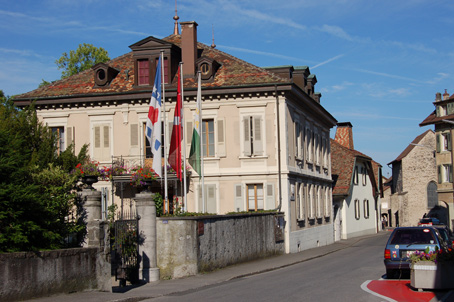
The Corsy countryside and the town hall
The estate known as Corsy (Chaplin Park), which includes the present municipal building, extends across the western half of the terrace whose eastern part is occupied by Le Châtelard. From the 18th century onwards, Corsy passed successively to the banker Aimé Grenier, brother of the assesseur baillival of Vevey, then to François-Louis de Tavel, bailli of Vevey, and finally to the Couvreu family, which from then on owned the two adjoining estates. According to the date engraved on the lintel of a door in the winegrowing outbuilding, this group of three buildings – the manor house, the rural outbuildings and the winegrowing dependencies – was built around 1655.
The manor house underwent a complete restoration completed in 1838, in which the prominent Vevey architect Franel – probably Philippe, mentioned in 1840 and 1843 in connection with works at the church of Corsier-sur-Vevey – may have taken part. It appears, however, to have been altered once more during the second half of the 19th century, perhaps around 1897, when the Couvreu family remodelled its southern façade by constructing the terrace with a neo-classical balustrade and the pavilion.
The manor house, rectangular in plan, is topped by a hipped roof with a series of dormer windows. The two residential floors above the cellars have, on both the north and south sides, four rectangular windows per floor, the closer spacing of the central pair creating a suggestion of a projecting section. The horizontal lines are strongly emphasised, first by a moulded stringcourse centred within a wide band running along three of the four façades, and second by the cornice decorated with modillions crowning each side. The band and the cornice divide the two storeys while continuing uninterrupted across the quoin stones that highlight the vertical structure of the façades.
The eastern entrance door is reached via a porch and a straight flight of steps flaring at its base. To the west remains the chamfered round-arched doorway giving access to the cellars, possibly dating from 1655. The outbuildings also preserve several early openings: the door dated 1655 and the two windows flanking it, the barn door and several narrow loophole-style apertures.
The interior layout of the manor house, highly symmetrical, features rooms arranged on either side of a longitudinal corridor. Noteworthy elements include a buffet front dating from 1658 and a tiled stove with painted tiles, probably from the 1770s.
This manor house is of considerable interest within 19th-century regional architecture, even though its exact date remains uncertain, all the more so if the hypothesis of architect Philippe Franel’s involvement in the 1838 works proves correct.
The flag / The adage
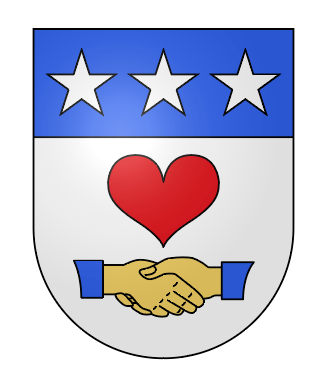
The coat of arms of Corsier-sur-Vevey is described in heraldic terms as follows: « Argent, a heart gules supported by clasped hands proper adorned azure; on a chief azure three mullets argent. »
The municipality’s motto is: « Through concord, small things grow. »
The municipalities of the “Riviera-Pays-d’Enhaut” district